Directive 2014/29/EU – Simple Pressure Vessels Directive (SPVD)
5 minutes

Structured Assessment Logic (SAL) – Your Roadmap for Compliance
SAL Type III - Safety Architecture Framework – NLF-based Risk-Specific Safety Framework
Mapping of SPVD 2014/29/EU
To implement the requirements of SPVD 2014/29/EU in a transparent and structured way, the regulatory assessment process can be represented using a Structured Assessment Logic (SAL). This logic ensures that all technical and regulatory requirements are systematically evaluated and that compliance is supported by documented evidence.
The SAL comprises the following steps:
Product qualification – Is the product actually within the scope of the Directive 2014/29/EU?
Identification of the applicable requirements – Which provisions of Annex I apply to the product, or is it to be manufactured in accordance with Sound Engineering Practice (SEP)?
Assessment of harmonised standards and, where necessary, other means of fulfilment where such standards are not applied or do not exist; or – where the vessel falls within the SEP range – determination of the technical specifications used to demonstrate compliance with Sound Engineering Practice (SEP).
Selection of the conformity assessment procedure – Module B (Design Type or Production) plus C, C1, or C2 – no module required for SEP.
Technical documentation – Which records demonstrate compliance?
Information and marking obligations
EU Declaration of Conformity & CE marking – Official confirmation of compliance, ready for the EU market.
Note: SAL is not an end in itself. It provides a repeatable methodology that translates regulatory principles into a clear, structured assessment logic.
This diagram illustrates the SAL workflow visually:
Product qualification
↓
Identification of the applicable requirements
↓
Harmonised standards / other means of fulfilment / SEP
↓
Conformity assessment procedure / SEP
↓
Technical documentation
↓
Information and marking obligations
↓
CE marking & EU Declaration of Conformity
Parallel applicability of legislation / Norm hierarchy and conflict of laws
Other Union harmonisation legislation may need to be taken into account. As part of the applicability assessment, it must be determined whether such acts apply in parallel or whether, due to rules of precedence and lex specialis principles, individual requirements or an entire harmonisation act is displaced in favour of another. Where no normative conflict exists, the respective requirements apply in parallel and cumulatively.
Overview: Directive 2014/29/EU
Number: 2014/29/EU
Title: Directive relating to the making available on the market of simple pressure vessels
Publication: OJ L 96, 29.3.2014, p. 45
Purpose: The Directive 2014/29/EU aims to ensure a uniform level of safety for simple pressure vessels throughout the European Union while at the same time facilitating their free movement within the internal market. To this end, it establishes harmonised conditions for the design, manufacture, and placing on the market of serially produced, welded pressure vessels intended to contain air or nitrogen and not designed to be fired.
Public interest: Protection from pressure-related risks to safety
Guidance: European Commission’s guidelines: Guidelines related to the Simple Pressure Vessels Directive 2014/29/EU (SPVD)
Scope
The provisions of the Directive apply to simple pressure vessels manufactured in series—defined as any welded vessel subjected to an internal gauge pressure above 0.5 bar, intended to contain air or nitrogen, and not designed to be fired.
Products excluded under Article 1(2), such as vessels specifically designed for nuclear use, vessels for installation in or propulsion of ships and aircraft, and fire extinguishers, are not covered by this Directive.
Identification of the applicable requirements
Vessels for which the product of PS × V exceeds 50 bar·litre must comply with the essential safety requirements set out in Annex I of the Directive, covering aspects such as materials, design, and manufacturing processes.
Vessels for which PS × V is 50 bar·litre or less must be manufactured in accordance with sound engineering practice in a Member State.
Harmonised Standards – Specification Demonstrating Compliance with SEP
Manufacturers should first consider harmonised standards as a means to demonstrate conformity with the Directive’s requirements. Where such standards are not applied or do not exist, other technical solutions can be used to fulfil the relevant requirements.
For vessels falling within the SEP range, compliance is instead achieved through technical specifications that reflect Sound Engineering Practice (SEP), ensuring that the vessel is designed and manufactured according to recognised rules of good engineering practice, independent of harmonised standards.
Conformity Assessment Procedures
Article 13 sets out the step-by-step conformity assessment route manufacturers must follow before simple pressure vessels can be placed on the EU market. In short, it defines when a notified body must be involved and how much oversight is required, based primarily on the risk indicator PS × V (maximum pressure × volume).
Design Stage: EU-Type Examination Required Above 50 bar·L
Before manufacturing begins, any vessel with PS × V > 50 bar·L must undergo an EU-type examination (Module B).
How this is done depends on whether harmonised standards are fully applied:
If Harmonised Standards Are Used
The manufacturer may choose between two options:
Module B – Design Type
Review of technical documentation only (no physical specimen examined).
Module B – Production Type
Documentation review plus examination of a representative prototype.
If Harmonised Standards Are Not (or Only Partly) Used
Module B – Production Type is mandatory
A prototype of the complete vessel must be assessed together with the technical file.
Production Stage: Assessment Before Market Placement
Once the design is approved, Article 13 defines how production must be checked.The level of control scales with PS × V, reflecting increasing risk.
PS × V Range | Required Procedure | Oversight Level |
> 3,000 bar·L | Module C1 – Conformity to type + supervised testing | Strong supervision with testing of vessels |
200 – 3,000 bar·L | Manufacturer chooses Module C1 or Module C2 | Either supervised testing or random inspections |
50 – 200 bar·L | Manufacturer chooses Module C1 or Module C | From supervised testing down to internal control |
SEP (PS × V ≤ 50 bar·L)
For vessels in the SEP range, no Module applies.
Compliance is achieved through manufacture according to Sound Engineering Practice, ensuring the vessel meets recognised rules of good engineering practice without formal involvement of a notified body.
Technical Documentation
The technical documentation shall provide sufficient evidence to demonstrate that the pressure vessel complies with the applicable legal requirements.
It shall include, in particular:
design documentation;
design calculations;
material specifications and certificates;
welding documentation;
test reports;
applied harmonised standards and other technical specifications;
risk assessments, where applicable;
the EU Declaration of Conformity; and
all other documentation necessary to demonstrate conformity.
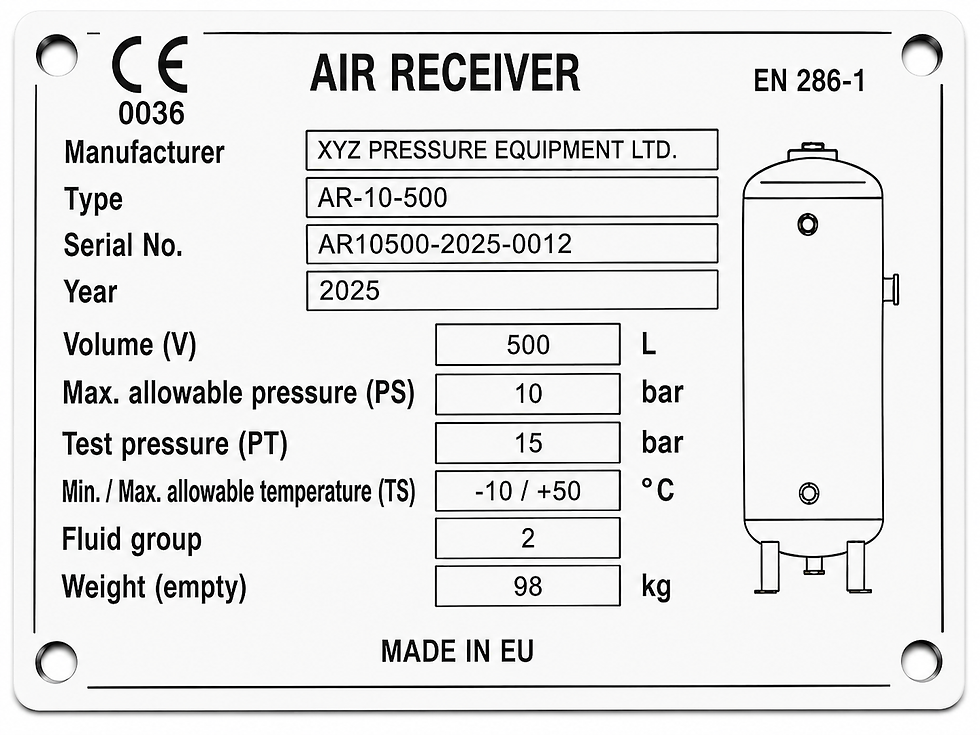
Information and Marking Obligations
Identification and manufacturer marking
User manual, safety information, Information according to Annex III
CE Marking
Mandatory before placing the product on the EU market
Must be visible, legible, and permanent
Notified Body number required if involved
Conclusion
With SAL, the mapping as a roadmap, and consideration of interfaces to related legislation, it becomes clear how SPVD 2014/29/EU is systematically applied. The final workflow logically follows from scope through requirements, standards, and assessment procedures to CE marking – providing a clear orientation for manufacturers, assessors, and all stakeholders seeking regulatory clarity.
You might also be interested in these articles:



© 2026 by Dr. Matthias K Bauer